ラベル i-イラク の投稿を表示しています。 すべての投稿を表示

2013/03/20

米軍の「軍隊内性トラウマ」


碑がいい、いや少女像だと言い争っている韓国系退役アメリカ軍人たちも、アメリカに建てるならこういった女性たちの碑の方が相応しいのではないか?

33パーセントというのはかなりの高率だが、ここで言われているレイプがどの程度の行為を指しているのかは分からない。セクハラが別カテゴリーになっている所を見ると、やはり我々が普通に想像するようなレイプということでいいのだろうか。被害者が女性兵士の三人に一人に上るというのは驚きである。これとは別に男性の被害者も存在する。


ところで昨年公開された映画に「The Invisible War」(見えない戦争)というドキュメンタリー映画がある。やはり米軍内部の性暴力を扱っている(未見)。米軍内にこういった問題が起こるのは、吉見理論に従えば、「大儀なき侵略戦争だから」「慰安婦制度自体が女性に対する性暴力を肯定しているから(現在の米軍に慰安婦所はないが、女性兵士の帯同がそれを代替しているという指摘はある)」などが理由として挙げられそうだが、恐らくこういった問題は米軍や日本軍に固有の問題ではないだろう。


この映画を見た人によれば、加害者が処罰されていない(場合も少なくない)、という話である。
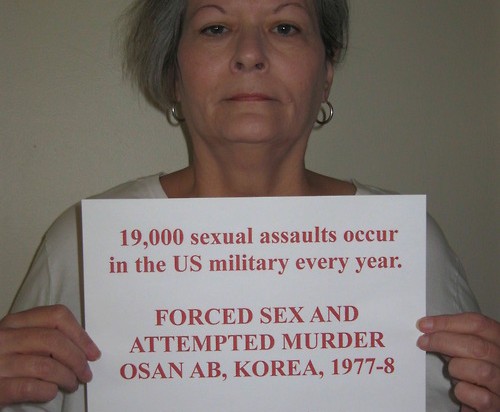
(Credit: I Am One)

被害はイラクやアフガニスタンにとどまらない。この女性は1970年代に韓国の烏山(オサン)空軍基地(米軍)での強制されたセックスと殺人未遂の被害を訴えている。彼女によれば、米軍内では毎年19,000件の性暴力事件が起こっている。

駐留部隊:米女性兵士の3割、軍内部でレイプ被害

米英軍主導の侵攻から20日で10年を迎えるイラクや国際部隊の駐留が続くアフガニスタンに派遣された米女性兵士延べ28万人の3割以上が、上官らから性的な暴行を受けていたことが分かり、米国内で「見えない戦争」と問題視されている。連邦上院の軍事委員会で13日、「軍内性的トラウマ(MST」と呼ばれる心的ストレスに関する公聴会が初めて開かれた。新たな被害を恐れ沈黙を余儀なくされてきた被害者は「風穴が開いた」と歓迎している。

カリフォルニア州図書館調査局が昨年9月に発表した実態調査によると、イラクとアフガニスタンに派遣された女性兵士の33.5%が米軍内でレイプされ、63.8%が性的いやがらせを受けたと回答した。国防総省も問題を認めている。軍内での性的暴力は2010年だけで、男性の被害も含め推計1万9000件にのぼる。

上院公聴会で議長を務めたバーバラ・ボクサー議員は「被害申告が出ているのは17%にすぎない」と指摘。「この問題の公聴会を開くのに10年もかかった。変革の第一歩だ」と意義を強調した。

イラク戦争中の03年にクウェートに派遣された前後に米国内基地で上官から性的暴力を受けたコーリン・ブッシュネルさん(39)は、公聴会をインターネットの生中継で見ながら「草の根運動で長年取り組んできたことがようやく公に明るみに出た」と興奮した。証言する予定だったが心的外傷後ストレス障害(PTSD)のため断念。議長の言葉に救われた思いがした。

クウェート派遣前に男性上官からレイプされ、帰還後に女性上官から性的暴力を受けた。「上官を訴えても自分を助けてくれる人がいると思えなかった」。精神的なバランスを崩し、06年に退役。2人の子供がいる家には帰れず、5年近くホームレス生活を続けた。「自分が恥ずかしく、行く場所がなかった」

05年のイラク派遣中に変死した女性米兵ラベナ・ジョンソンさんの両親が、自殺と断定した軍に「殺害された」と異議を唱えていることを知った。ジョンソンさんの遺体には、殴られ、レイプされたと見られる痕が残っていた。下士官時代のつらい記憶と重なり「彼女の無念を伝えるのが使命」と感じた。昨年夏から3カ月、全米12州の退役軍人組織を巡る行脚に出た。

退役軍人庁の11年の統計によると、ホームレスの女性退役軍人のうち39%が軍内性暴力の被害者だ。市民団体「女性兵士行動ネットワーク」によると、10年に退役軍人庁のPTSD認定基準が緩和されたが、MSTは申請の32%しか認められていない。全体平均は53%だ。

米国防総省は1月、直接戦闘地域への女性派遣を禁ずる規定の撤廃を発表した。ブッシュネルさんは女性の戦闘任務参加を歓迎しつつ、「今ですら性暴力の告発は難しい。最前線で公正な判断ができるのだろうか」と不安を語った。【ロサンゼルス堀山明子】

毎日 2013.3.19

2010/12/21

I didn't think of Iraqis as humans【イラク】現代の金子安次


イラク戦争の狂気。

英語版のウィキペディアの慰安婦の項目には金子安次の証言 "The women cried out, but it didn't matter to us whether the women lived or died. We were the emperor's soldiers.(女が泣こうが関係なかった。我々は天皇陛下の兵士だったから)"が引用されているが、彼の証言の信憑性は置くにしても、戦場の非日常性はどの時代にも共通なのだろう。


'I didn't think of Iraqis as humans,' (自分はイラク人を人間だとは思っていなかった) says U.S. soldier who raped 14-year-old girl before killing her and her family

An Iraq War veteran serving five life terms for raping and killing a 14-year-old Iraqi girl and killing her parents and sister says he didn't think of Iraqi civilians as humans after being exposed to extreme warzone violence.

Steven Green, a former 101st Airborne soldier, in his first interview since the 2006 killings, claimed that his crimes were fuelled in part by experiences in Iraq's violent 'Triangle of Death' where two of his sergeants were gunned down.

He also cited a lack of leadership and help from the Army.

'I was crazy,' Green said in the exclusive telephone interview from federal prison in Tucson, Arizona. 'I was just all the way out there. I didn't think I was going to live.'

Green talked about what led up to the March 12, 2006, attack on a family near Mahmoudiya, Iraq, that left him serving five consecutive life sentences.

The former soldier, who apologised at sentencing for his crimes, said he wasn't seeking sympathy nor trying to justify his actions - killings prosecutors described at trial in 2009 as one of the worst crimes of the Iraq war.

But Green said people should know his actions were a consequence of his circumstances in a war zone.

'If I hadn't ever been in Iraq, I wouldn't be in the kind of trouble I'm in now,' Green said. 'I'm not happy about that.'

Green was discharged with a 'personality disorder' before federal charges were brought against him.

Prosecutors sought a death sentence, but a federal jury in Paducah, Kentucky, opted for five life sentences on charges including the rape and murder of 14-year-old Abeer Qassim Al-Janabi and the shooting deaths of her mother, father and younger sister.

Four other soldiers were convicted in military court for various roles in the attack. Three remain in military prison.

Green is challenging the Military Extraterritorial Jurisdiction Act, which allows the federal government to charge an American in civilian court for alleged crimes committed overseas. He was the first former soldier convicted under the statute. The U.S. 6th Circuit Court of Appeals has scheduled arguments for January 21.

Green is challenging the constitutionality of that law, saying it gives the executive branch too much leeway over whom to prosecute. Prosecutors say the law should be upheld.

'I've got some hope, but I'm not delusional about it,' said Green, now 25. 'I hope it works. But, whenever they give you multiple life sentences, they're not planning on letting you out.'

Green didn't testify at trial. During sentencing, he apologized and said he expects to face 'God's justice' when he dies.
Abeer Qassim al-Janabi, Green's 14-year-old victim, whose parents and sister were also murdered in the attack. Green said deaths of two of his colleagues had 'messed him up real bad'

Abeer Qassim al-Janabi, Green's 14-year-old victim, whose parents and sister were also murdered in the attack. Green said deaths of two of his colleagues had 'messed him up real bad'

A 19-year-old high school dropout from Midland, Texas, Green joined the Army after obtaining his high school equivalency diploma from a correspondence school.

He said signing up was easy, born of a sense of duty to defend his country and the opportunities that offered.

'I thought I'd be neglecting my duty if I didn't,' Green said. 'You've got a career, you've got a job. It gives you opportunities to do things with your life.'

The military placed Green with the Fort Campbell-based 101st Airborne. Upon arriving in Iraq, Green said, his training to kill, the rampant violence and derogatory comments by other soldiers against Iraqis served to dehumanise that country's civilian population.

A turning point came on December 10, 2005, Green said, when a previously friendly Iraqi approached a traffic checkpoint and opened fire.

The shots killed Staff Sgt. Travis L. Nelson, 41, instantly. Sgt. Kenith Casica, 32, was hit in the throat. Casica died as soldiers raced him aboard a Humvee to a field hospital.

Green said those deaths 'messed me up real bad.'

The deaths intensified Green's feelings toward all Iraqis, whom soldiers often called by a derogatory term. 'There's not a word that would describe how much I hated these people,' Green said. 'I wasn't thinking these people were humans.'

Over the next four months, Green sought help from a military stress counsellor, obtaining small doses of a mood-regulating drug - and a directive to get some sleep before returning to his checkpoint south of Baghdad.

In the interview, Green described alcohol and drugs being prevalent at the checkpoint. Green said soldiers there frequently felt abandoned by the Army and were given little support after the deaths of Casica and Nelson.

Spc. James P. Barker of Fresno, California, testified that he pitched the idea of going to the al-Janabi family's home to Sgt. Paul E. Cortez of Barstow, California, who was in charge of the traffic checkpoint.

Green, who talked frequently of wanting to kill Iraqis, was brought along.

Cortez testified that Barker and Green had the idea of having sex with the girl and that he didn't know the family would be killed.

Green, then a private,saidhe had 'an altered state of mind' at the time. 'I wasn't thinking about more than 10 minutes into the future at any given time,' Green said. 'I didn't care.'

At the Iraqi home, Barker and Cortez pulled Abeer into one room, while Green held the mother, father and youngest daughter in another.

Pfc. Jesse V. Spielman, of Chambersburg, Pennsylvania, stood guard in the hall. As Barker and Cortez raped the teen, Green shot the three family members, killing them.

He then went into the next room and raped Abeer, before shooting her in the head. The soldiers lit her remains on fire before leaving. Another soldier stood watch a few miles away at the checkpoint.

Since his sentencing on September 4, 2009, Green has been attacked at the federal prison in Terre Haute, Indiana, and was then transferred to Arizona.

In prison, Green converted to Catholicism and has corresponded with a nun in Louisville about his faith.

Green described prison life as a 'lonely existence' and said other inmates consider those convicted of sex offenses among the lowest, making life 'hazardous' among the general prison population.

For Green, each day is just a matter of getting through 24 hours so he can do it all again the next day. Meanwhile, he lives with memories of the attack that took away the Iraqi family.

'If I thought that was an OK thing now, I wouldn't be much of a human being,' Green said.

Mail Online 20th December 2010